

Last reviewed: October 3, 2026
The short answer
An FBI background check for teaching English abroad is the FBI’s Identity History Summary, run on your fingerprints, and South Korea’s EPIK, Spain’s language assistant and long-stay student visas, China and Vietnam work permits, Japan’s JET Program and Taiwan’s cram schools all ask for one. Most want it dated within 6 months and apostilled by the U.S. Department of State ($20 a document, up to 5 weeks by mail); Taiwan wants legalization instead, and JET wants the FBI’s own copy with no apostille.
U.S. citizens and green card holders who are in the U.S. can order it through an FBI-approved channeler, such as the $170 check at Fingerprint Boston in Tewksbury. Everyone else files with the FBI directly.
FBI background check for teaching English abroad, country by country
Each country was checked against official pages on October 3, 2026. Lists change between intakes, so confirm your own program’s list.
| Country | FBI check? | How recent | Apostille or legalization | Translation |
|---|---|---|---|---|
| South Korea, EPIK | Yes, national level only | Within 6 months of contract start | State Department apostille | Not asked for |
| Spain, language assistants and students | Yes, for stays of 180 days or more | Within 6 months before arrival | State Department apostille | Spanish, sworn or certified translator |
| China, work permit and Z visa | Yes | Within 6 months (Shanghai) | Apostille since November 7, 2023 | Ask the employer |
| Japan, JET Program | Yes, once selected | Issued after September 1, 2026, for the 2027 program | None | None requested |
| Taiwan, cram schools | Yes | Not set; ask the school | Legalization by TECRO | Chinese, only if asked |
| Vietnam, work permit | Yes | Within 6 months | Apostille since September 11, 2026 | Vietnamese, certified |
South Korea: EPIK and the E-2 visa
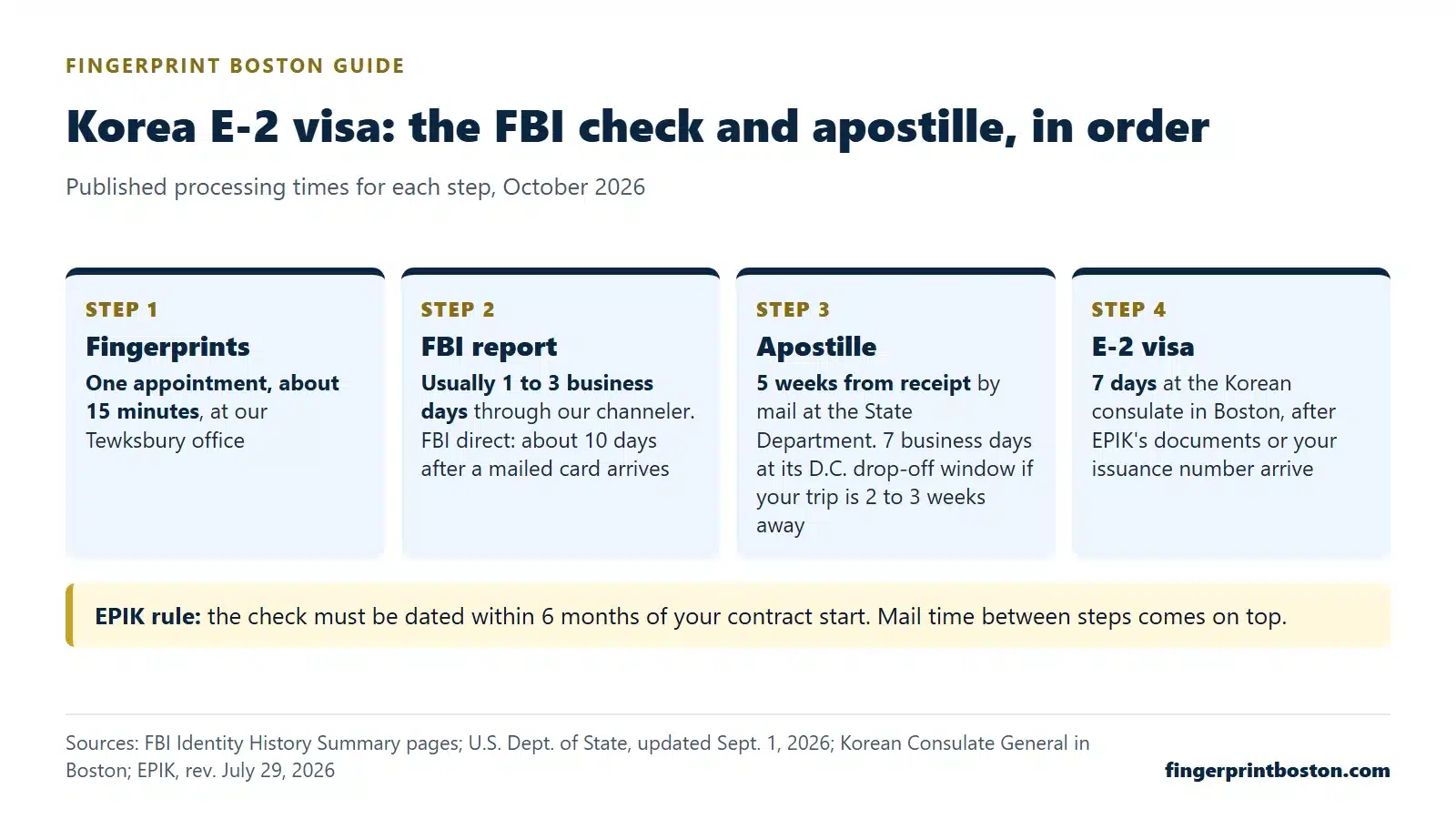
EPIK wants the check from “a national police authority,” which for Americans means the FBI, “dated within 6 months of the contract starting date,” and dated August 1 or later for a February start. It needs a physical State Department apostille on the original; a state apostille on a notarized copy “will not be accepted” (EPIK guide, read October 3, 2026). Channeler checks are accepted if they can be apostilled (EPIK FAQ). The Korean consulate, in Newton, takes applications in person from residents of five New England states and lists 7 days of processing (visa notice, January 1, 2025); private academy hires bring a visa issuance number instead of EPIK papers (E-2 page, June 24, 2025). Fingerprint Boston’s E-2 visa timeline covers the dates.
Spain: auxiliares de conversación and student visas
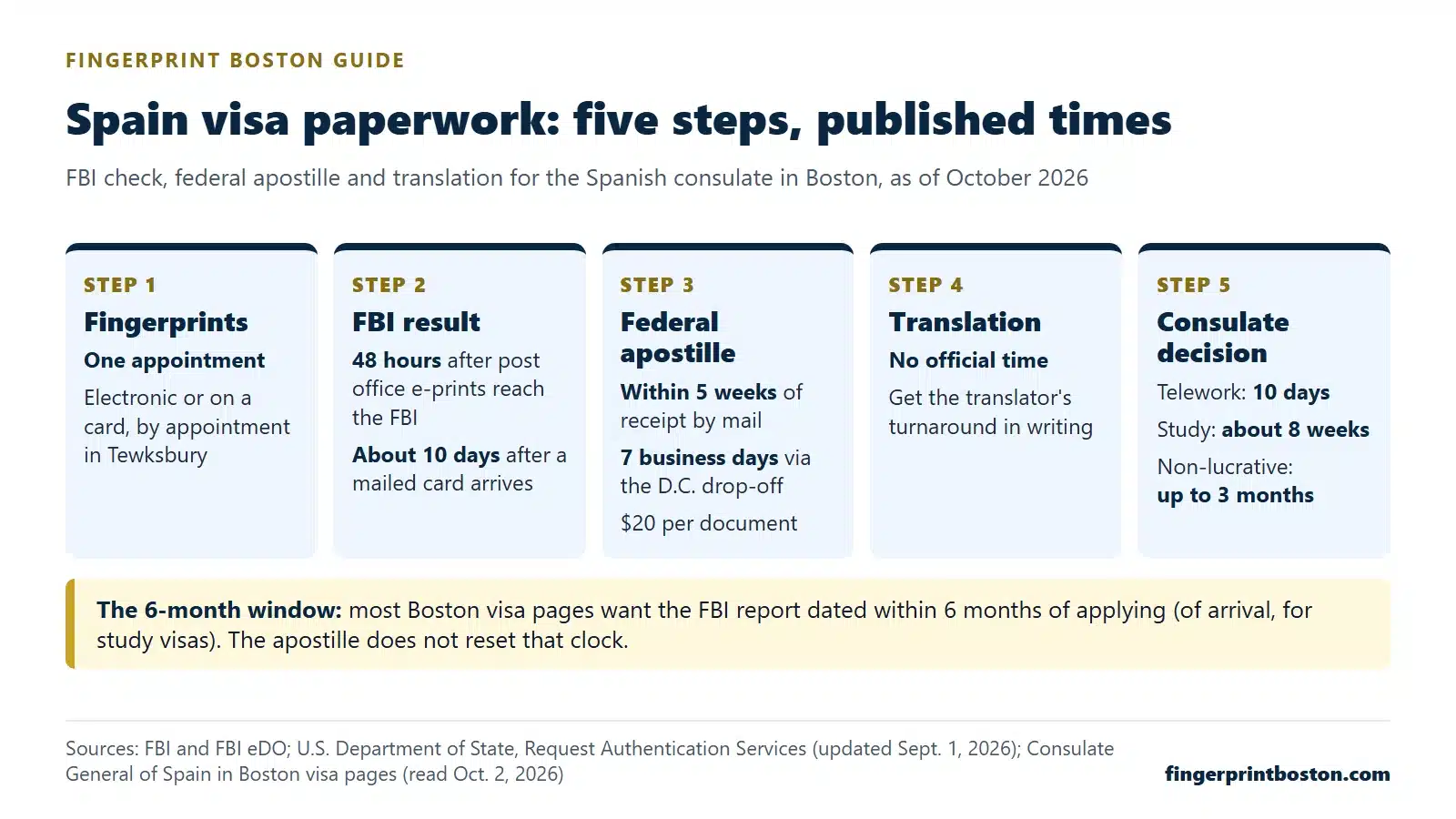
Spain’s Boston consulate serves the same five states. Language assistants staying 180 days or more need an FBI check “verified by fingerprint comparison,” dated no more than 6 months before arrival, apostilled and translated into Spanish by a sworn or certified translator; the apostille itself needs no translation. State or local certificates are refused, as is anything “damaged (including staple removal damage)” (language assistant page, May 20, 2025). You apply in person at BLS, 15 Court Square, and U.S. citizens pay $160 in cash. The student visa page (March 9, 2026) applies the same rule past 180 days, quotes about 8 weeks and says to apply at least 2 months before your flight. Both want a record from any country where you lived 6 months or more in the last five years. Fingerprint Boston’s Spain visa paperwork guide covers other visa types.
China: the work permit behind the Z visa
Your employer applies in China for a work permit notification letter; with it you get the Z visa at a Chinese consulate, then the permit after entry (Shanghai FAQ, December 15, 2023). That file includes “certificates of no criminal record” (Hunan government, June 15, 2026), and Shanghai’s work permit guide says one “issued within six months is valid.” Since November 7, 2023, U.S. documents need only an apostille, though the Chinese Embassy says to confirm format, time limit and translation with the receiving party (embassy notice, October 24, 2023).
Japan: the JET Program
JET Program USA asks for the FBI check once you are selected, and most candidates should wait for the final acceptance notice before requesting it (JET FAQ, read October 3, 2026). Its 2027 sheet wants a check issued after September 1, 2026, takes the FBI’s unopened paper copy or the FBI’s own email with link and PIN, refuses “Emailed/printed PDF’s” and asks for no apostille (JET FBI sheet, revised September 2026). A channeler’s PDF does not fit, so request the check from the FBI directly.
Taiwan: cram schools and legalization
A cram school hiring a foreign teacher must file a “certificate of good conduct” from the teacher’s passport country with the first work permit application; the law sets no age limit, so ask the school (Supplementary and Continuing Education Act, Article 9, amended June 14, 2017). Taiwan is outside the Apostille Convention, so TECRO in Washington legalizes the FBI check by mail: $15 and 10 business days, or $22.50 and 3. A result straight from the FBI goes to TECRO directly; a channeler result needs the State Department first. A Chinese translation, if asked for, is authenticated by your regional TECO office (TECRO instructions, updated July 22, 2026).
Vietnam: the work permit
Decree 219/2025/ND-CP asks for a criminal record certificate no more than 6 months old in a foreign worker’s permit file, with a certified Vietnamese translation (Lang Son Department of Home Affairs guidance, December 2025). Since September 11, 2026, an apostille replaces legalization: the Vietnamese Embassy says an apostilled U.S. document “may be used in Viet Nam without any further certification,” with a translation notarized or certified under Vietnamese law (embassy notice, September 10, 2026).
Thailand: not in the table yet
Thailand’s teacher license document list was not available on an official page today, so it is not in the table. Confirmed: the Royal Thai Consulate-General in New York, which covers Massachusetts, legalizes only documents bearing the State Department’s seal and accepts no apostilles (consulate page, March 27, 2025), and the Apostille Convention reaches Thailand on February 28, 2027 (HCCH status table).
The order of steps
- Get the document list in writing
Which check, how recent, which certificate, which translation, and the earliest and latest dates the check can carry.
- Match your name to your passport
Use the passport spelling, full middle name included.
- Get fingerprinted and request the check
Through a channeler if you qualify, or the FBI’s eDO portal, whichever produces the format your destination accepts.
- Leave the result alone
Keep a JET envelope sealed, leave staples in place and never notarize the report.
- Send it to the State Department if needed
Form DS-4194 names the country, which decides between an apostille and an authentication certificate. JET skips this, as does a Taiwan check that came straight from the FBI.
- Add legalization where required
TECRO for Taiwan; the Thai consulate until February 28, 2027.
- Translate last, then file
Spain and Vietnam want the translation after the apostille.
A planning calendar
Work backward from your start or arrival date and add mail time between steps; the State Department says a package marked delivered still takes several days to reach review. The directory’s guide to FBI background check timing compares the FBI routes.
| Before start or arrival | Step | Published time |
|---|---|---|
| About 6 months | Earliest date for the check under 6-month rules | EPIK counts from contract start, Spain from arrival |
| 5 to 4 months | Fingerprints and FBI request | Channeler: 1 to 3 business days (Fingerprint Boston). FBI direct: about 48 hours after post office prints, about 10 days after a mailed card arrives |
| 4 to 3 months | State Department certificate | Within 5 weeks of receipt by mail |
| About 3 months | Legalization and translation | TECRO: 10 business days, or 3 expedited |
| 3 to 2 months | Visa or permit filing | Spain students: about 8 weeks. Language assistants: 4 to 6 weeks. Korea: 7 days |
| Program dates | EPIK and JET calendars | EPIK spring term: documents October to January, visa January to February (EPIK timeline). JET: after final results in April 2027 |
Who can use the $170 channeler, and who files with the FBI directly
The FBI says a channeler “may only process requests for a U.S. citizen or U.S. lawful permanent resident located in the U.S. or its territories,” and sends employment and licensing checks to state identification bureaus instead (FBI page). Work abroad is a separate purpose, though JET notes that not every channeler handles overseas employment, so ask before you book.
For U.S. citizens and green card holders in the U.S. The $170 covers fingerprint capture, a technician review, electronic submission through Fingerprint Boston’s FBI-approved channeler and the FBI’s own fee. Results usually arrive in 1 to 3 business days as a PDF, the office says.
For everyone else, and for JET. Open an eDO request, then give prints at a participating post office, where “additional fees may apply,” or mail a fingerprint card. Fingerprint Boston rolls FD-258 cards for $59.95, $25 for each extra card.
Route 2 is the one international graduates use. A Canadian who finished a degree in Massachusetts and applies to EPIK needs an apostilled check from the degree country too, and a channeler cannot take that request. The FBI handles direct requests in date order, does not expedite, and sends results by email with a link and PIN, plus a paper copy if you select it (FBI eDO FAQ).
Match the name on your passport
The FBI says the name on your result “will match the name that you entered” on the request. TECRO is the strictest office we found: the name “must exactly match” your passport or green card, and a missing middle name, an initial in place of a full middle name or reversed names means an FBI correction before TECRO will act. Use the passport spelling everywhere, hyphens and suffixes included.
Apostille versus notarization
A notary watches you sign. An apostille or authentication certificate confirms an official’s signature and seal, not the content; the State Department says authentication “does not verify the contents of a document.” The FBI check is federal, so only the U.S. Department of State can apostille it, and it says: “Do not notarize your original document. Your document will no longer be valid if it is notarized” (apostille page and authentication page, June 16, 2026).
Your diploma goes the other way: EPIK has U.S. applicants notarize a copy of the degree, then get the state’s apostille (EPIK degree guide), the route the directory’s Massachusetts apostille guide explains. And an apostille never stretches a 6-month window; the Spanish consulate says it is “equally limited” by the document’s own validity (consulate apostille page).
The State Department step: $20 a document, up to 5 weeks by mail
The Office of Authentications charges $20 for each document and processes mail “within 5 weeks from the day we receive it” (State Department, updated September 1, 2026). Send Form DS-4194 with the country of use, a check or money order and a prepaid USPS or UPS return envelope. For trips 2 to 3 weeks away, its Washington office takes drop-offs Monday to Thursday, 7:30 to 9:00 a.m., without an appointment, and processes them within 7 business days. The FBI will not forward your result there, so this step is yours or your agent’s.
Fingerprint Boston can take the prints, get the FBI result and file the State Department apostille, with handling quoted with your request. Its FBI check and apostille page explains the service, and why FBI apostille requests get rejected lists what sends packets back.
Mistakes that cost a placement
Check these before anything goes in the mail
- Getting the check too early. A check dated before EPIK’s intake date or JET’s September 1 cutoff, or older than 6 months for Spain or Vietnam, is redone, apostille and all.
- Sending a state check. Spain refuses state certificates and EPIK refuses anything below national level. A Massachusetts CORI is a name-based state record, not a fingerprint-based national check.
- Notarizing the FBI report. The State Department says a notarized original is no longer valid.
- Opening or unstapling. JET refuses opened envelopes and printed PDFs; Spain refuses staple damage.
- A name that differs from the passport. TECRO sends it back for an FBI correction.
- Waiting until you are abroad. Channelers serve only people located in the U.S., and the U.S. Embassy in Seoul says it cannot provide or apostille an FBI check (embassy page, April 10, 2023).
Getting it done from Lowell and the Merrimack Valley
Fingerprint Boston is the fingerprinting office at 1215 Main Street, Unit 115, in Tewksbury, on Route 38 next to Lowell, open by appointment only on weekdays. Its FBI background check fingerprinting uses the $170 channeler route. Bring your passport and your program’s document list; the office does not file anything with a consulate or foreign government. For other counters, see every place to get fingerprinted in Lowell and the directory’s Lowell fingerprinting guide.
Questions people ask
Do I need an FBI background check to teach English abroad?
For every country in this guide, yes. South Korea’s EPIK, Spain’s language assistant and long-stay student visas, China and Vietnam work permits, Japan’s JET Program and Taiwan’s cram schools all ask for one. They differ on age limits, apostille or legalization, and translation, so get your program’s current list in writing first.
Can I use a Massachusetts CORI or a state police check instead?
No. The Spanish consulate in Boston requires a check issued by the FBI and verified by fingerprint comparison, and it refuses state and local police certificates. EPIK accepts only national-level checks. A Massachusetts CORI is a name-based state record with no fingerprints, so it does not replace the FBI’s national check.
How recent does the FBI check have to be?
EPIK wants it dated within 6 months of your contract start, and August 1 or later for a February start. Spain counts 6 months back from arrival. Vietnam’s work permit rules say 6 months, as does Shanghai’s guide. JET’s 2027 program wants a check issued after September 1, 2026. An apostille never extends these windows.
I am not a U.S. citizen or green card holder. Can I use the $170 channeler check?
No. The FBI limits channelers to U.S. citizens and lawful permanent residents located in the United States. Everyone else requests the check from the FBI through its eDO portal for $18, then gives fingerprints at a participating post office or mails a fingerprint card. Fingerprint Boston can roll that card for $59.95 by appointment.
Should I notarize my FBI report before the apostille?
No. The State Department says a notarized original is no longer valid. The FBI result is a federal document, so the State Department apostilles the original itself, and EPIK rejects a state apostille placed on a notarized copy. Notarized copies are for documents such as your diploma.
Can I get the FBI check after I move abroad?
Yes, but it is slower. Channelers serve only people located in the United States, so from abroad you request the check from the FBI directly and mail a fingerprint card. The U.S. Embassy in Seoul cannot provide or apostille an FBI check, though it says Korean district police stations take fingerprints free. Finishing before you leave is simpler.
Sources, opened October 3, 2026, with page dates given above: EPIK record guide, degree guide, FAQ, timeline; Korean consulate E-2 page, visa notice; Spanish consulate language assistants, study visa, apostille; Chinese Embassy notice; Hunan; Shanghai guide, FAQ; JET USA FAQ, FBI sheet; Taiwan Article 9; TECRO; Vietnamese Embassy notice; Lang Son guidance; Royal Thai Consulate legalization; HCCH; State Department services, apostille, authentication; FBI summary checks, eDO FAQ; U.S. Embassy Seoul.
Book the FBI check near Lowell
Fingerprint Boston takes fingerprints by appointment at 1215 Main Street, Unit 115, Tewksbury, Monday to Friday, 10 AM to 5 PM, with same-day slots when the schedule allows. The FBI check is $170 with the channeler and FBI fees included, FD-258 cards are $59.95, and apostille handling is quoted with your request. Call (978) 424-4629 or book online; payment is taken when you book.
Book a fingerprint appointmentDisclosure: LowellBusiness.com and Fingerprint Boston share an owner. Prices and rules on this page were checked against the sources listed on October 3, 2026.