
Fingerprinting in Lowell MA: The Working Person’s Guide to Background Checks, Licenses and International Paperwork
Lowell has always been a city where people work with their hands and build lives across borders, from the mill floors of the 1840s to the hospital corridors, classrooms and kitchens of today. Both halves of the inheritance show up in an unexpected place: fingerprints. The working city generates constant fingerprint demand through healthcare hiring, school employment and professional licenses. The international city generates its own stream through citizenship filings, foreign pensions, adoptions and the document chains connecting Lowell families to Cambodia, Brazil, Portugal, India and West Africa. Sooner or later, a form lands on nearly every Lowell kitchen table with the same instruction: get fingerprinted.
This guide is for the moment the form arrives. It walks through every common reason Lowell residents need prints, decodes the confusing parts of the paperwork, explains what each service costs, covers the international cases this city produces more than most and lays out the practical logistics, since a full-service private fingerprinting office sits fifteen minutes down Route 38 in Tewksbury. Read the section matching your situation and skip the rest. Or read it all and become the person your family calls when their form arrives.
The Job Reasons: Healthcare, Schools and Licensed Work
Start with employment, since work drives most fingerprint appointments in Greater Lowell. Healthcare leads by volume. Lowell General, the clinics, the home care agencies and the long-term care facilities ringing the city hire continuously. Clinical roles carry background screening as a condition of the first shift. Aides, nurses, techs and support staff all cycle through checks during onboarding, some name-based, some fingerprint-based depending on the role, the facility and the program funding the position, with federal program participation frequently deciding the difference. A rejected or delayed check postpones a start date, which for an hourly worker means postponed pay, so the quality of the capture matters in direct dollar terms.
Education runs second. Massachusetts requires fingerprint-based national checks for school employees, so every teacher, paraprofessional, custodian, cafeteria worker and bus driver entering the Lowell schools or the surrounding districts gets printed, along with many contractors working inside buildings. The private side mirrors it: daycares, after-school programs, tutoring centers and camps screen under childcare rules and their own policies. Massachusetts school and licensed childcare fingerprints run through the state’s SAFIS system, which only IdentoGO centers can capture, so Fingerprint Boston cannot take those prints. Anyone building a career around children in this city should expect fingerprinting as a recurring career event, not a one-time errand.
Licensed trades and professions fill out the picture. Securities and mortgage professionals print under federal rules. Real estate, insurance, healthcare licensure and various trade certifications each carry their own screening layers. And the growing gig and security workforce, guards, drivers, contractors on secured sites, meets fingerprint requirements through employers and platforms. The common thread across all of it: the requirement letter tells you which check, which codes and which method. Keep the letter. Bring the letter. The letter is the appointment.
The Life Reasons: Citizenship, Adoption, Pensions and Records
Lowell’s second stream of fingerprint demand has nothing to do with a boss. Citizenship and immigration filings lead this category in a city where roughly a quarter of residents were born abroad. Naturalization applicants attend biometrics appointments through the federal immigration system itself, but the wider family of international filings, visa applications for relatives, foreign residency, dual citizenship claims, overseas property matters, routinely requires an FBI Identity History Summary obtained through a fingerprinting provider, often followed by further authentication covered below.
Adoption brings whole households in together. Domestic and international adoption programs fingerprint every adult in the home, sometimes every member above a threshold age. International programs layer FBI checks with apostilles on top. Foreign pension and benefit claims form a quieter stream with deep Lowell roots: retirees who worked decades in Portugal, Brazil or Southeast Asia before settling here must periodically prove identity and clean records to foreign benefit systems. The proof runs on fingerprints. Finally, a steady line of people simply want their own record, checking what the FBI file says before a job search, correcting an error or satisfying a foreign government’s request. Requesting your own Identity History Summary requires no employer and no lawyer. The process is mapped in the guide on requesting your own FBI record.
Decoding the Paperwork Nobody Explains
Every fingerprint journey begins with a document written by an agency for an agency. The decoding step defeats more applicants than the fingerprinting itself. Three code types carry the meaning. An ORI number identifies the agency receiving your results, functioning as the routing address for the entire submission. An OCA number ties the submission to your specific case or file. A service code, where present, tells electronic systems which program and fee schedule applies. Together they answer the only question the technician needs answered: where do these prints go?
The method instruction hides in plainer language. Electronic, Live Scan or channeler means digital capture transmitted directly. FD-258, card or the presence of a mailing address means rolled ink prints on the standard federal card, handed to you for mailing. When the letter is ambiguous or arrived in a language easier for your parents than for the agency, photograph it and send it to the provider before booking. A provider worth using reads requirement letters daily and identifies the right service at no charge, which beats guessing with your money. The comparison between the two capture methods is laid out plainly in Live Scan versus ink card fingerprinting.
What Each Service Costs
Published pricing removes the anxiety of the unknown counter. At Fingerprint Boston, the service operating from 1215 Main Street in Tewksbury, electronic Live Scan runs $79.95. Traditional FD-258 ink cards run $59.95 with the blank cards supplied, plus $25 for each additional card rolled in the same visit, worth taking when an agency wants duplicates. FBI background checks run $170, with the FBI-approved channeler’s fee and the FBI’s own fee included, paid online when you book. That check is for personal review, visas and paperwork abroad, not for U.S. jobs or licenses: the FBI says an approved channeler “cannot process a request for employment and/or licensing purposes.” Certain programs add their own government processing fees, named before capture rather than discovered after. The complete menu with examples sits on the pricing page.
One honest budgeting note for working families: the cheapest print is the one accepted the first time. A bargain capture rejected for quality costs the original fee, the resubmission wait and sometimes a start date. Professional capture with real-time quality checking costs a few dollars more and removes the risk where it matters most, on the worn, worked hands this city is full of. Kitchen workers, cleaners, machinists, healthcare aides and anyone decades into manual work carry flattened ridges needing a careful technician, which is precisely the skill worth paying for once instead of twice.
The International Chain: From Fingerprints to Apostille to Translation
Here is the section Lowell needs more than any city in the region. When your FBI report is headed to a foreign government, the report alone is often not the finish line. Many foreign authorities require the report authenticated with an apostille, a federal certification proving the document is genuine, and countries outside the Hague Apostille Convention ask for embassy legalization instead. Countries operating in other languages typically require certified translation of the authenticated package. Applicants who learn this after mailing a bare report overseas lose a month getting it back and starting the authentication properly.
The chain runs in strict order: fingerprints first, the FBI Identity History Summary second, the apostille on the report third, translation last so it covers the apostille certificate too. Supporting documents, birth records, marriage certificates, diplomas, run a parallel track with their own authentication rules, each apostilled by the state or federal office issuing it. For the Cambodian grandmother’s pension paperwork, the Brazilian couple’s property transaction, the Portuguese family’s citizenship-by-descent claim covering three generations of records, the chain is the same shape at different scales. The complete step-by-step walkthrough, including timelines, validity windows and the mistakes eating whole months, is published in the guide to FBI background checks and apostilles for visas and citizenship, and the authentication itself runs through Neighborhood Parcel’s apostille service in the same Tewksbury building as the fingerprinting.
The practical payoff of one roof deserves a sentence of its own. A Lowell family managing an international filing comes in once, gets printed, sets the FBI request in motion with the destination country named, routes the returned report straight into apostille processing and hands the authenticated package to translation without ever coordinating a second vendor. Families running the chain across separate providers in separate towns spend seasons on what one coordinated pass finishes in weeks.
How Long Everything Takes: A Realistic Lowell Timeline
Timelines cause more stress than fees, so here are the honest ranges. The appointment itself takes ten to fifteen minutes. Electronic submissions reach receiving agencies immediately, with results returning on each agency’s clock, commonly a few business days for channeled FBI requests and longer for state program queues. Mailed ink cards add postal time on both ends, so card-based submissions realistically run two to four weeks door to door. The federal apostille on an FBI report adds several weeks of processing through the State Department queue when mailed directly, one of the strongest arguments for professional handling of the authentication step. Certified translation adds roughly a week depending on language and page count.
Stack the chain for an international filing and the well-managed version runs six to ten weeks from fingerprints to a consulate-ready package. The unmanaged version stretches past four months with depressing reliability, usually through one of three failures: a report rejected for print quality, a document mailed to the wrong authentication office or a vital record expiring while everything else processed. Every one of the three is preventable in the first week. Work backward from your deadline, subtract the destination’s freshness window for the background check and the date you land on is your fingerprinting date. Deadline pressure never improves prints, timelines or family harmony, so the earliest safe start is the right start.
What Shows Up on the Record
Fear of the unknown keeps a surprising number of people from checks they would pass easily, so plain facts help. The FBI Identity History Summary reflects fingerprint-based submissions reported to the federal system over a lifetime: arrests, the charges behind them and case outcomes where agencies reported one. People with no arrest history receive a response stating no record was found, which is the outcome for the large majority of employment and licensing applicants. Old matters resolved decades ago sometimes appear with missing dispositions, since reporting depended on the agencies involved. The record owner holds the right to challenge and correct errors through a defined federal process.
Two reassurances land here. First, a records check is not an immigration status check. The fingerprinting provider is a private service capturing prints for the request you brought in, nothing more. Second, checking your own record before an employer or consulate does is a legitimate, common and often wise move, exactly so surprises surface on your timeline instead of theirs. The correction process for errors is documented in the guide on fixing mistakes on an FBI record, and people use it successfully every week.
Students, New Grads and First Licenses
Lowell educates its own workforce. The pipeline from UMass Lowell and Middlesex Community College into nursing, education, criminal justice and social work runs straight through fingerprinting. Clinical placements print students before hospital rotations. Student teaching prints future educators before classroom hours. First professional licenses print new grads before the credential issues. The pattern for students is timing: placement offices announce requirements on short deadlines, September and January cohorts hit together and the students who book the week the requirement drops walk past the line their classmates stand in.
Two student-specific notes earn their space. First, name consistency. Students who enrolled under one name and license under another, common across international and married students, should bring the documents connecting the names, since a mismatch between the ID, the application and the submission is the top cause of counter delays. Second, keep your receipts and result letters in one folder from the first placement onward. Licensing boards ask for screening history at surprising moments. The student who kept the folder answers in minutes.
Families, Elders and Getting Everyone Printed
Plenty of Lowell fingerprint appointments arrive as households: an adoption printing both parents and the adult brother upstairs, a citizenship filing covering grandparents, a family visa application reaching every adult in the home. Group bookings handle these in one visit with back-to-back slots, which matters when coordinating elders, work schedules and childcare. Children print gently with lighter pressure and patience. A parent or guardian attends with ID for any minor.
For elders and anyone homebound, the service travels. Mobile visits bring capture equipment to homes, senior residences and care facilities across Greater Lowell, solving in one house call what a family might spend weeks arranging around mobility, transportation and stairs. A foreign pension requirement should never go unmet because the person who earned the pension no longer drives. The mobile option covers exactly this case, alongside the employer group visits described in the mobile fingerprinting guide for Massachusetts, and pairing a home visit with a traveling notary through HireMobileNotary.com handles the signature side of the same paperwork in the same sitting.
For Lowell’s Community Organizations and Nonprofits
The city’s nonprofit layer, the community development corporations, the mutual aid networks, the cultural associations, the refugee resettlement programs, sits at the intersection of both fingerprint streams. These organizations screen their own staff and volunteers under youth protection and funding requirements while simultaneously guiding clients through immigration and benefit paperwork requiring the international chain. Both roles get easier with a standing relationship instead of a scramble.
On the screening side, volunteer cohorts behave like employer cohorts: a mentoring program clearing twenty volunteers before the school year books one group visit instead of twenty errands, with the forms and codes verified once for everyone. The specifics for volunteer organizations, including which programs typically require national checks, are covered in the guide on fingerprinting for volunteers, coaches and nonprofits. On the client services side, caseworkers who understand the fingerprint-to-apostille chain save their clients months. A caseworker is welcome to call with a client’s requirement letter and get it decoded together, in whatever shape the letter arrived. Community organizations printing regularly should also ask about scheduled visit arrangements, since predictable volume earns predictable scheduling.
One more resource worth naming for this audience: presentations. Organizations serving immigrant communities regularly ask for a plain-language walkthrough of the document chain for their clients. A provider who serves this population daily brings real answers rather than generic ones. Ask when you call. Lowell’s institutions have always worked best when they work together. Paperwork help is a form of neighboring as old as the city itself, practiced today in requirement letters and appointment slots instead of boarding houses and union halls, but practiced all the same.
The Logistics From Lowell
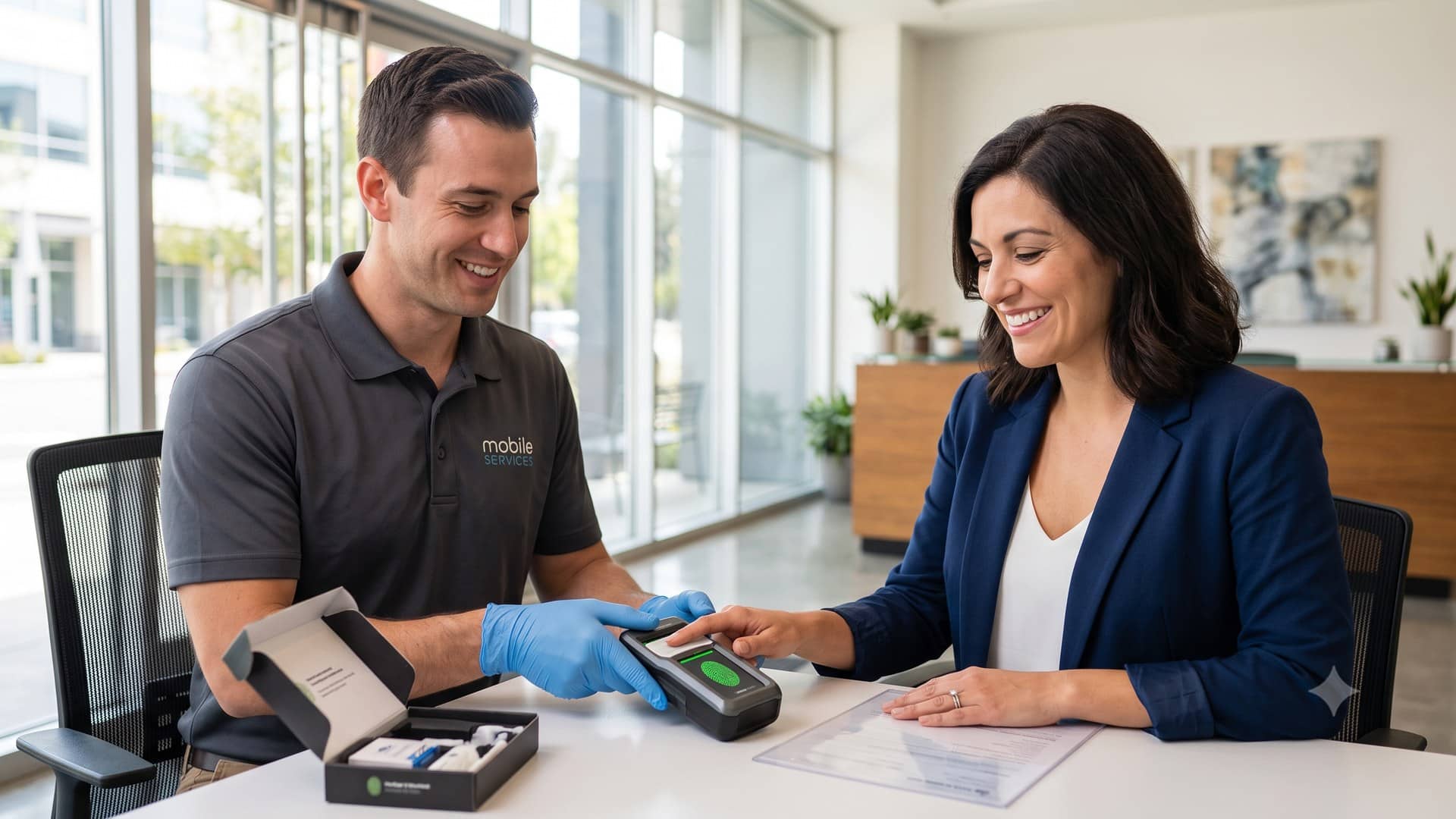
Fingerprint Boston’s office sits at 1215 Main Street, Unit 115 in Tewksbury, a straight run down Route 38 from downtown Lowell, about fifteen minutes from the Acre or Centralville with free parking at the door, a detail downtown Lowell cannot offer. Appointments run Monday through Friday, 10 AM to 5 PM, by appointment only, which is why capture takes fifteen minutes with no line. Booking happens online at fingerprintboston.com/contact in under a minute or by phone at (978) 424-4629, where the person answering will also decode a confusing requirement letter for free. Lowell-specific service details live on the dedicated Lowell fingerprinting page.
Bring three things: an unexpired government photo ID, the requirement letter or instructions with any codes and blank cards if an agency mailed them. Payment is taken online when you book. Hands in good condition help more than people expect, so moisturize for two days beforehand and skip harsh cleaning chemicals the morning of the visit, advice aimed squarely at the kitchen, cleaning and clinical workers this city runs on. Arrive five minutes early on a first visit, since finding Unit 115 in the plaza takes a moment, then never again.
Questions Lowell Residents Ask Most
My requirement letter is confusing. Who reads it with me?
The provider, for free, before you book. Photograph the letter and send it over or bring it to the phone call. Two minutes of decoding prevents paying for the wrong service, which is the most expensive mistake in the whole process. Letters in any condition are welcome, including the ones agencies write as if nobody will ever read them.
Do I need an appointment or do I walk in?
Appointment, booked online or by phone, usually available same week. The appointment model is why the visit takes fifteen minutes instead of an afternoon and why elders and workers on break get in and out on schedule.
My fingerprints are worn from years of work. Will they even read?
Almost always, with careful capture. Worn ridges need adjusted pressure, patience and real-time quality grading so weak images get redone in the chair. Hydrate your hands for a few days beforehand. In the rare case a program rejects prints twice for quality, most shift to a name-based review, with the rejection letters as documentation.
My FBI report is going to another country. What else do I need?
An apostille on the report, nearly always, plus certified translation when the destination country operates in another language. Say the destination at your fingerprint appointment so the whole chain gets planned from the first step. The full sequence with timelines is in the visa and citizenship document guide linked above.
The Short Version
Fingerprinting is a fifteen-minute task wrapped in an hour of confusion. The confusion is optional. Keep the requirement letter, let a professional decode it for free, book ahead of the seasonal rushes, prepare your hands and name the destination country when paperwork is headed abroad. Lowell built itself on people who handle their business, across languages, borders and generations of worn, working hands. The fingerprint step deserves the same treatment: done once, done right, fifteen minutes down Route 38. Book at fingerprintboston.com or call (978) 424-4629.